Easing
Easing functions for smooth animations and transitions.
Header: #include <asw/modules/easing.h>
Namespace: asw::easing
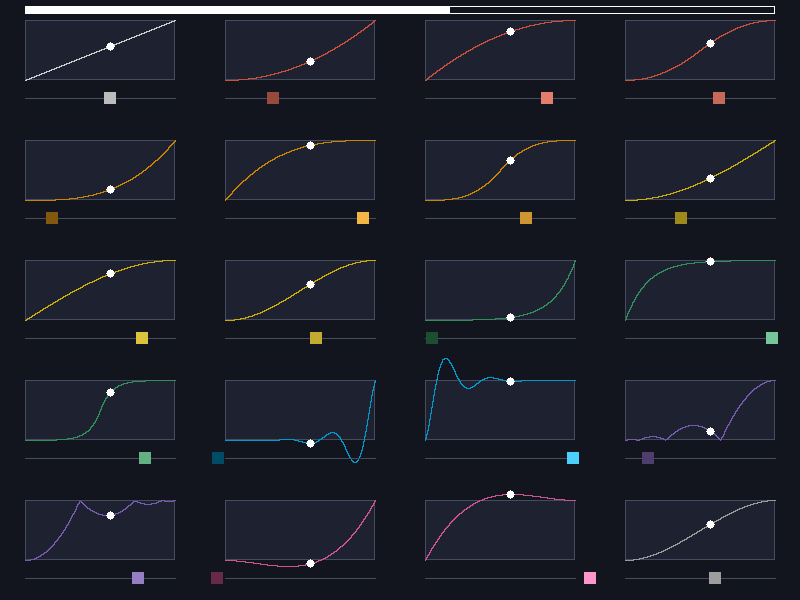
From the easing example.
Functions
All easing functions take a progress value t (0.0 - 1.0) and return the eased value.
Linear
| Function | Description |
|---|---|
linear(float t) | No easing, linear interpolation |
Smoothstep
| Function | Description |
|---|---|
smoothstep(float t) | Soft at both ends, 3t² - 2t³ |
Quadratic
| Function | Description |
|---|---|
ease_in_quad(float t) | Accelerating from zero |
ease_out_quad(float t) | Decelerating to zero |
ease_in_out_quad(float t) | Acceleration then deceleration |
Cubic
| Function | Description |
|---|---|
ease_in_cubic(float t) | Accelerating from zero (steeper) |
ease_out_cubic(float t) | Decelerating to zero (steeper) |
ease_in_out_cubic(float t) | Acceleration then deceleration (steeper) |
Sine
| Function | Description |
|---|---|
ease_in_sine(float t) | Sinusoidal ease in |
ease_out_sine(float t) | Sinusoidal ease out |
ease_in_out_sine(float t) | Sinusoidal ease in and out |
Exponential
| Function | Description |
|---|---|
ease_in_expo(float t) | Exponential ease in |
ease_out_expo(float t) | Exponential ease out |
ease_in_out_expo(float t) | Exponential ease in and out |
Elastic
| Function | Description |
|---|---|
ease_in_elastic(float t) | Elastic spring effect (ease in) |
ease_out_elastic(float t) | Elastic spring effect (ease out) |
Bounce
| Function | Description |
|---|---|
ease_in_bounce(float t) | Bounce effect (ease in) |
ease_out_bounce(float t) | Bounce effect (ease out) |
Back (Overshoot)
| Function | Description |
|---|---|
ease_in_back(float t) | Slight overshoot (ease in) |
ease_out_back(float t) | Slight overshoot (ease out) |
Convenience
falloff
float falloff(float t, asw::Falloff mode);Get how far a gradient or light has faded at a distance from its center. t goes from 0 at the center to 1 at the edge. The result goes from 0 at the center to 1 at the edge. See Falloff.
ease
template <typename T, typename Func>
T ease(const T& a, const T& b, float t, Func func);
Apply an easing function and interpolate between two values. The progress t is clamped to 0.0 - 1.0. T must be an arithmetic type, and Func must be a callable that takes a float and returns a float.
Integer types are calculated in floating point, so a falling unsigned range does not wrap. If an easing goes past the end (e.g. ease_out_back), the result is clamped to the range of T.
| Parameter | Type | Description |
|---|---|---|
a | const T& | Start value |
b | const T& | End value |
t | float | Progress (0.0 - 1.0) |
func | Func | Easing function or callable to apply |
Example
float progress = elapsed_time / total_time;

// Ease a float value
float x = asw::easing::ease(0.0f, 100.0f, progress, asw::easing::ease_out_quad);

// Use a lambda as the easing function
float y = asw::easing::ease(0.0f, 100.0f, progress, [](float t) {
  return t * t * t;
});

// Use individual functions directly
float t = asw::easing::ease_out_bounce(progress);